“To have a heart for the nations, one must first have a heart for the lost.”
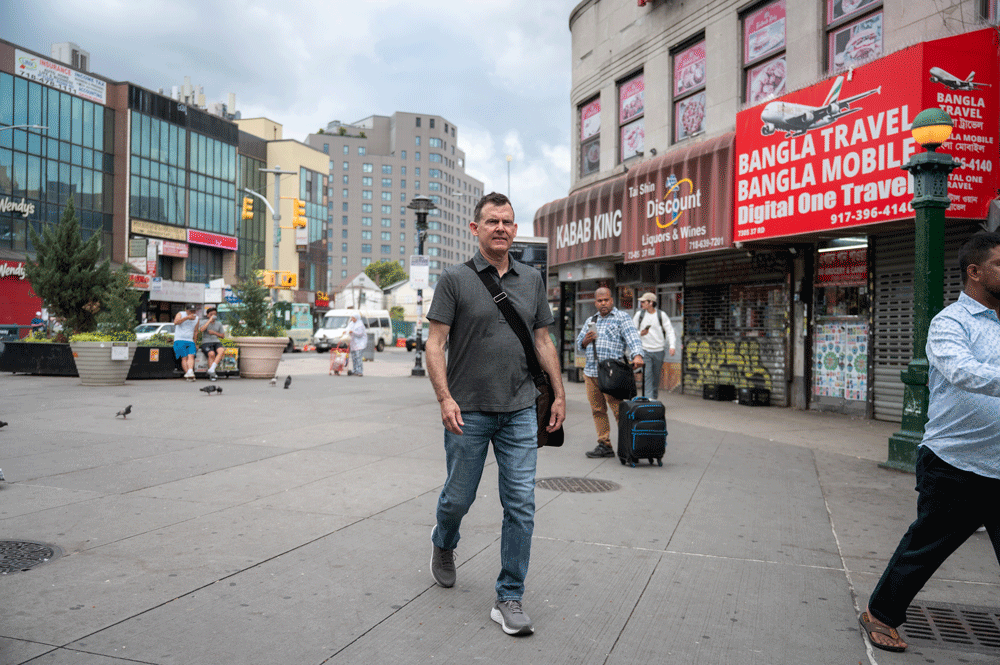
This is what Kevin King ’90 shared with me, as he sat next to his wife, J*, in the office of their Brownstone apartment building in the Harlem neighborhood of New York City. It is a singular sentence that serves as an effective summary of what they shared over the two interviews I had with them. Among the whos, whats, whys, wheres, and hows that the Kings shared regarding International Project’s 30-year history, it is evident that “a heart for the lost” has driven every decision.
A Campus Love Story
Kevin and J met as students at Cairn University in 1989 while running on the cross country team. J, a freshman, chose to study at Cairn because she had desired to be a missionary since she was a young teen. Kevin was a more recent believer, and in his senior year, he was looking to attend seminary after graduation to become a pastor. The two began dating shortly before Kevin graduated and continued while he earned his Master of Divinity from Missio Seminary in Philadelphia. Over the course of those three years of biblical study, it became clear: Kevin and J were both called to be full-time missionaries, and they were called to do so together. The day after J’s last class at the University, they were married on campus in a pond-side ceremony off of Pine street—the last ceremony to be held there, as construction of the president’s residence began immediately after.
An Unmet Need and a Timely Mission
Kevin and J both had a strong desire to be missionaries among an unreached people group. They began praying and asking God where he would have them serve in the 10/40 window. It was during this same time that a friend invited them to see the ministry potential in New York City. What they found shocked them: Over 90,000 international students, 100,000 West African Muslims in one neighborhood, 80,000 Bangladeshi Muslims in another neighborhood, and 60,000 Arab Muslims in yet another neighborhood. Rather than living among one unreached people group across the ocean, the Kings realized the potential to live among the dozens of unreached people groups that were already converging in NYC. While, thankfully, many missions organizations have recognized and are participating in this diaspora ministry in the US, that was not the case in the early ’90s. The Kings had a vision for a new kind of missions that didn’t follow the typical playbook of crossing saltwater. Rather than moving halfway across the world to establish themselves in an entirely new culture, the Kings wanted to minister to the stranger next door. To be full-time financially supported missionaries who stayed stateside was nearly unheard of, which made it difficult to find an organization to support their work. They prayed and patiently waited for God to bring them to an organization that would support them—and that’s exactly what he did. The Kings found stateside missionary support from WorldTeam, giving them the opportunity to lay the foundation for what would become International Project.
For the first 10 years, they focused their efforts on campus ministry. English conversation groups, discovery Bible studies, and invitations to leave cafeteria food behind in exchange for a home-cooked meal were the order of the day. They built relationships with international students, shared the gospel, and discipled those who could then return home to share that same message with their families and communities. They were amazed at what God was doing. Over a five-year period, they saw seven house churches start in other countries as students returned home to make disciples.
As they continued to build relationships and establish themselves in the city, they expanded their focus to more broadly cover diaspora, including international students but also immigrants, refugees, and diplomats. Their vision with immigrants and refugees was the same as that on campus: To see the gospel spread through these new diaspora believers and see the gospel carried through relational lines to start churches in closed countries. Through International Project teams, they have seen churches begin in Iran, West Africa, and Bangladesh.
A Sending Agency of Their Very Own
For years, Kevin and J were International Project—two supported missionaries with a heart for internationals living in New York City. They were eager to add more missionaries to their team, but that process was slow-going. They started to host missionary trainings while they waited for full-time team members. The Equip Missionary Training Program, a one-year program focused on training cross-cultural church planters to start simple multiplying churches, is something they began in 2010 and continue to do today. Missions organizations from all over the country would send their new missionaries to the Kings for training—but then they would leave, continuing on their journey to do missions across the globe. The Kings came to the realization that as long as they were missionaries sent by a larger agency, they would never have the focused support they needed for their unique missions strategy of reaching diaspora communities in the US. They needed all of the resources “in house” to recruit, train, and retain a team of missionaries committed to their same mission.
In 2012, International Project officially became a sending organization. This move brought renewed focus to their diaspora ministry and streamlined their ability to serve these communities in the ways in which they felt the Lord leading.
This decision opened the door for incredible opportunity and growth, but it also came with considerable challenges. Training, mobilization, HR, finances, and pastoral care are just a few of the time-consuming and weighty responsibilities that must smoothly run behind the scenes in order for missionaries to be well-supported to do their jobs well. The Kings’ schedules were already full with the ground work of missions, so in order to succeed as an independent ministry, they needed a lot more help. But where the workload increased, God provided the workers. International Project grew from just Kevin and J to about 40 missionaries in an eight-year period. In addition to these missionary workers, they have a ten-person operations and mobilization team to support this work.
Opportunities to Expand
Campus ministry is still a significant part of International Project’s strategic plan to reach unreached people groups in NYC and, by extension, around the world. They have an average of 15 different discovery Bible studies every week across two college campuses. But the campus ministry team, led by J, is only one of eight teams that International Project now sends out. They have five teams in New York City: the campus team, two teams reaching Arabs, a team reaching South Asian Muslims, and a team reaching South Asian Hindus. They have also expanded their ministry footprint past NYC. They have a team reaching the Hindu population in Dallas, TX, and they have two teams in Rome and Central Asia to minister to the immigrant and refugee populations entering Europe.
In addition to the missionary teams, International Project also runs two thrift stores and community center in Brooklyn, staffed with another 35 employees. Both of these locations offer practical resources to the community while serving a greater, spiritual purpose. They provide a no-cost public space for ministry to happen. They offer specially designed groups and programs for immigrants and refugees, as well as a wider number of services to the broader community such as food distribution and various communal groups like kitting and art groups. Physical space in New York City is costly, but this ministry platform has proven to be a worthy investment in the extension of International Project’s presence and impact in the city.
Serving as International Project President, Kevin works with all of these teams—setting organizational vision and goals and providing training and support to the workers. For a time during their ministry expansion, Kevin was running most of the internal operations of International Project, which pulled him away from the direct ministry. But now a 10-person operations team has taken up the majority of this work, allowing Kevin to lead the organization while continuing to do the work of ministry that he desires to spend his time on—missionary training, dinner table conversations, and walking side by side with those who need to hear the good news of Jesus Christ.
Challenges to the Mission
International Project has had many causes for celebration in its three decades of operation—both in terms of organizational growth and its participation in the spread of the gospel throughout the world. They have also faced significant challenges. Attrition is one of these challenges. This challenge is not unique to International Project but one which all missions organizations face: Missionaries leave. The work is hard, expectations are not met, family dynamics change priorities, and the list goes on. What makes attrition for International Project especially difficult is their location. Choosing to minister in a city means choosing to live in a small apartment with a lot more noise, a lot more trash, and a lot more people—all at a lot higher of a cost.
“Reaching unreached people groups used to mean going to live in a jungle or a village,” said Kevin. “While these situations still exist, that paradigm of missions has quickly changed because the majority of people—including the unreached—now live in cities. The new sacrifice of missions is being willing to be stacked on top of each other.”
Politics have also proven to be a continuing challenge to International Project’s mission. The Kings believe that God, who sovereignly rules over all things, is “divinely orchestrating global migration.” But too often, the politics of immigration cloud the conversation of gospel ministry to the foreigner among us—occasionally resulting in angry emails from those who conflate International Project’s mission to minister to the foreigner with their endorsement of any particular border policy. International Project’s focus is not on lobbying immigration policies but effectively building relationships and sharing the gospel with those God has brought to their neighborhoods, no matter what policies are in place. As Kevin said, “This is an opportunity to reach the nations, regardless of politics. Our focus is not on one’s government status in the country but one’s spiritual status in the Kingdom of God.”
A Continuing Work
It is hard to tell the story of International Project apart from the Kings. In many ways, it is their story. It has been 32 years since their pond-side wedding on Cairn’s campus, and for 30 of those years, they have worked side-by-side in a ministry that they built from the ground up. It’s a story they get to share, a legacy that deserves to be celebrated. But at the same time, we recognize that this is, ultimately, God’s story. Lord willing, International Project will continue to reach unreached people groups around the world long after the Kings are gone. And even if International Project, the 503c, were to end before the Lord’s return, the International Project—the Great Commission of bringing the gospel to Judea, Samaria, and the ends of the earth—would continue, because the Lord has said it to be so.
If you are interested in serving with International Project, visit internationalproject.org.
*Identity hidden due to the sensitive nature of her ministry work.